
Lifestyle
Living and Working in the Same Small Room

What this covers
-
Zoning Is the Skill, Not Shopping
-
The Sightline Rule
-
Do Not Put the Desk in Front of the Window
-
Sound Travels Because Nothing Stops It
-
Power Is a Layout Constraint, Not a Detail
-
What Happens to the Things That Were on the Desk
-
The Guest Problem
-
The Order to Do This In
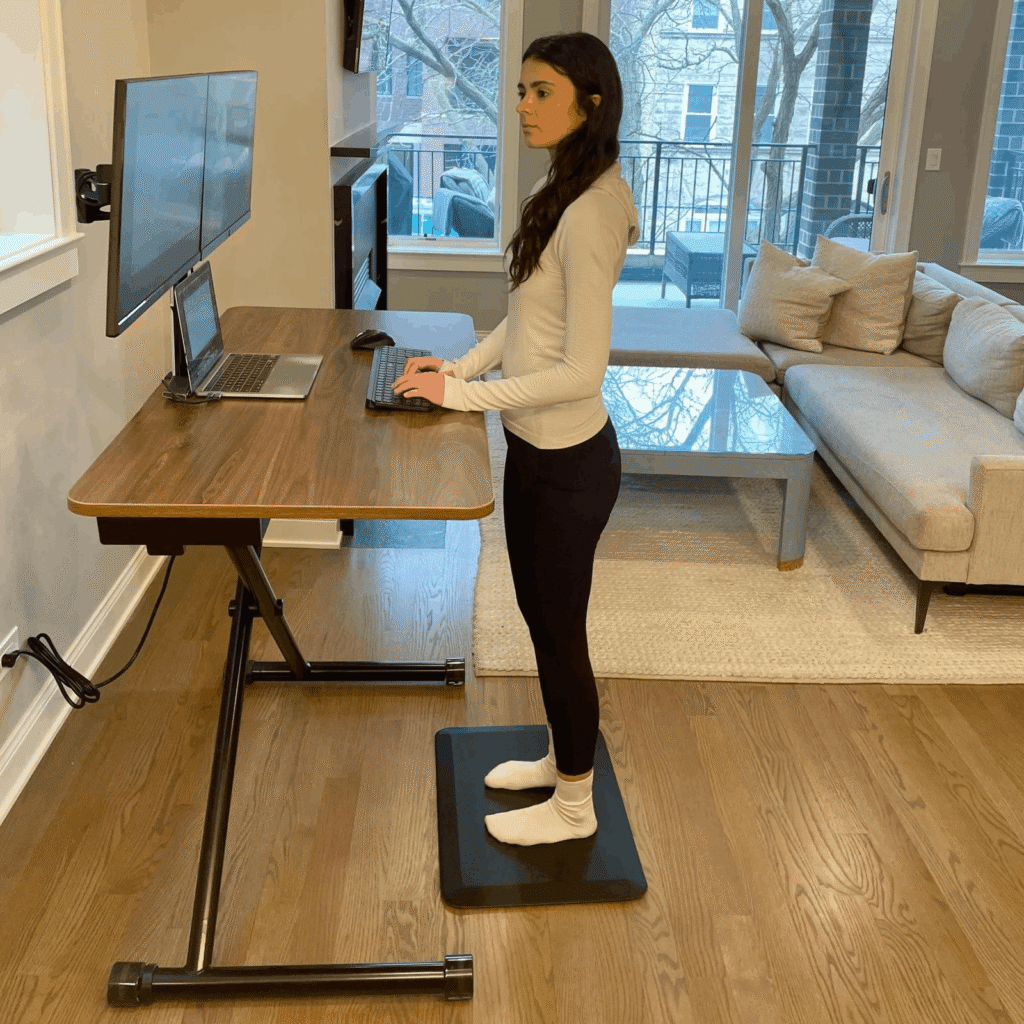
Advice for small workspaces usually starts and ends with buying a smaller desk. In a studio that misses the actual problem, which is not that the room is small. It is that the room already has a job.
A studio apartment has no interior door between the sleeping area and the living area. Everything happens in one volume of air. So the layout question is not how to fit a desk in. It is how to fit a desk in without the room stopping being somewhere you want to be at eight in the evening.
Zoning Is the Skill, Not Shopping
Zoning divides one room into areas by function rather than by walls. You have no walls to work with, so you use every other boundary available: floor covering, lighting, furniture orientation, and the direction things face.
The tools that actually work in a rented studio, in rough order of how much they do for you:
-
A rug. A rug defines a zone boundary without reducing floor area. It is the single most effective divider in a room where you cannot build anything, and it costs no square footage at all.
-
Furniture backs. The back of a sofa or a bookcase is a wall as far as the eye is concerned. Turning one piece around does more than adding two.
-
Separate light sources. A room lit by one ceiling fixture is one zone. A room with a desk lamp and a floor lamp is two, and you switch between them.
-
Orientation. Two chairs facing each other is a seating area. Two chairs facing a desk is an office. Same chairs.
None of that requires permission from a landlord, and none of it is permanent.
The Sightline Rule
This is the one that matters most and gets skipped most.
A sightline from the bed to the desk keeps work visible during rest hours. If the last thing in your field of view before sleeping is a monitor and a stack of paper, the room is still an office at midnight. People describe this as a sleep problem and treat it with an eye mask when it is a layout problem.
The fix has three tiers, in order of effectiveness:
-
Put the desk out of the bed’s sightline entirely, even if that means a worse desk position
-
If that is impossible, angle the bed so the desk sits behind the headboard
-
If neither works, the desk has to physically go away at the end of the day
Tier three is why folding matters in a studio in a way it does not in a house with a spare room. The desk that disappears is the one that lets the room change character, and a permanent desk in a small studio will stay in the sightline no matter how neatly it is tidied.
Do Not Put the Desk in Front of the Window
A single window sets the orientation of every piece of furniture in a studio. It is the only light source that changes through the day and the only view, so the instinct is to put the desk in front of it.
That instinct produces a specific problem. A desk placed in front of a window puts the worker in backlight on video calls. The camera exposes for the bright window behind you and you become a silhouette. Every meeting, permanently, until somebody mentions it.
Better positions, in order:
-
Window to one side, ideally the side your writing hand is not on
-
Facing into the room with the window behind the screen at ninety degrees
-
Facing the window only if you can cover it with a sheer curtain during calls
Side light is also the more comfortable option for long sessions. It lights the desk without putting a bright rectangle in your peripheral vision for eight hours.
Orientation is worth planning against the clock rather than against the floor plan, because the one window in a studio behaves differently depending on which way it faces.
|
Window faces |
Light through the day |
What it means for the desk |
|
North |
Even and indirect all day |
The easiest case; almost any orientation works |
|
South |
Bright, with a strong middle of the day |
A sheer curtain is doing real work by noon |
|
East |
Strong early, flat by afternoon |
Good for early starts, needs a lamp after lunch |
|
West |
Flat in the morning, harsh late |
Late afternoon glare lands on the screen |
A west-facing studio is the one that catches people out. The room is comfortable to view an apartment in at midday and difficult to work in at four in the afternoon, which is exactly the hour nobody is there during a viewing.
Sound Travels Because Nothing Stops It
Sound carries across a studio because no interior wall interrupts it. A keyboard, a call, a video, a kettle. If somebody else lives there, this is often the thing that causes friction rather than the floor space.
Soft surfaces are the only practical answer in a rented room. Rugs, curtains, upholstered furniture and anything on the walls absorb reflections; bare floor, bare walls and glass return them. A studio with one rug and one curtain sounds noticeably different from the same studio with neither, and neither requires a drill.
Power Is a Layout Constraint, Not a Detail
In a studio there are usually fewer outlets than there are things that need one, and they are all in the wrong place.
A desk needs power permanently if the desk adjusts electrically, and the cable run from the desk to the outlet crosses whatever floor is between them. In a one-room apartment that floor is also the walking route.
Two things reduce this to a manageable problem:
-
A power strip mounted to a desk frame reduces the desk to one cable. Everything on the desk plugs into the desk, and the desk plugs into the wall once.
-
Routing that cable along a baseboard rather than across open floor, held with removable clips rather than anything adhesive that will strip paint at move-out.
Some desks built for small spaces integrate the strip and the cable routing into the frame for exactly this reason, which turns a five-cable problem into a one-cable problem before you have bought a single clip.
What Happens to the Things That Were on the Desk
This is the part almost every small-space guide forgets, and it is the reason a lot of folding arrangements quietly fail.
Desk accessories occupy storage when the desk is stored. The monitor, the keyboard, the notebook, the charger and the mug all have to be somewhere. If the answer is “the floor beside where the desk was”, the room has not actually been returned.
Solutions that hold up:
|
Item |
Where it goes |
Why it works |
|
Monitor |
Stays mounted on the desk via an arm |
Travels with the desk, never handled |
|
Keyboard and mouse |
A single shallow drawer or a box on a shelf |
One grab, one place |
|
Cables |
Stay on the desk, on the frame |
Never unplugged, never untangled |
|
Paper and notebooks |
A vertical file on a shelf, not a pile |
Piles spread, files do not |
|
Laptop |
Wherever it already lives overnight |
It was always going to move |
The principle is that anything which can stay attached to the desk should. Every item that has to be moved separately adds time to the teardown, and teardown time is what decides whether the routine survives past week two.
The Guest Problem
Every studio layout gets tested the first time somebody comes over, and that is usually when the working arrangement is judged honestly.
A desk that cannot be cleared is the thing that makes a studio feel like a room somebody works in rather than a home. The monitor is the largest single offender, because it is tall, it faces one direction, and it reads as office equipment from anywhere in the room.
Three moves cover most of it:
-
The desk goes away, which takes the monitor with it if the screen is on an arm
-
The desk stays and the surface clears completely, which requires somewhere for the objects
-
The desk turns to face a wall, which is the weakest option and still better than nothing
Whichever applies, it is worth doing once as a dry run rather than discovering on the night that the teardown takes twenty minutes. A studio that resets in under two minutes is a studio you will actually invite people into.
The Order to Do This In
Lay a studio out in this sequence and it tends to come out right the first time:
-
Place the bed first. It is the largest object and the one with the fewest valid positions.
-
Establish the sightline from the pillow and decide what is allowed to be in it.
-
Place the desk out of that sightline, with the window to one side.
-
Check the walking route from door to bed to kitchen. Nothing should cross it.
-
Put a rug under the seating zone to separate it from everything else.
-
Only then work out where the desk goes at night.
Doing it in that order means the desk is fitted around the room’s existing job rather than the other way around, which is the whole trick. Floor space returned at the end of the day is the measure of a small-room layout, not how neat it looks at two in the afternoon.
A studio that works is not one where the desk is invisible while you are using it. It is one where the desk is invisible when you are not.
Many senior media executives build their careers entirely inside the industry, moving from one network, studio, or platform environment to the next. David C. Leavy took a different route. Before spending more than 25 years across Discovery Inc. and Warner Bros. Discovery, he served as Chief Spokesman and Senior Director of Public Affairs for the National Security Council in the Clinton White House.
That detail is not incidental. It is a foundational credential that helps explain the range and durability of his work across Discovery, Warner Bros. Discovery, and now CNN Worldwide. For David Leavy, public service established a communications discipline rooted in accountability, institutional credibility, and precision before his career expanded into corporate affairs, commercial strategy, and global media operations.
A Communications Background Built on Accountability
The National Security Council is not a communications environment defined by routine messaging. The work is consequential, the audiences are demanding, and the margin for imprecision is narrow. For an executive who later managed global communications and government relations at a multinational media company, that early experience provided a foundation in communication under serious institutional scrutiny.
David Leavy brought that discipline with him when he joined Discovery Inc. following his White House service. Corporate communications at a media company involves different subject matter, but the underlying demands carry forward: consistency, clarity, judgment, and the ability to manage relationships across competing institutional interests.
That public service background also matters because it shaped his work before his media career became defined by large corporate milestones. It gave David C. Leavy experience in a setting where communication was inseparable from institutional trust, a theme that would remain visible throughout his later executive roles.
The Transition From Government to Broadcasting
The move from the National Security Council to Discovery required more than a change of industry. It required translating the habits of a government communicator into the faster-moving, commercially oriented environment of cable television and, later, streaming.
Within Discovery, David C. Leavy progressed into roles of increasing organizational scope, eventually serving as Chief Corporate Operating Officer. That progression was not limited to communications. His responsibilities expanded across corporate strategy, government relations, public policy, corporate affairs, and operational oversight.
The breadth of that trajectory is difficult to separate from the public service foundation that preceded it. Government communications at the National Security Council required coordination, judgment, and the ability to operate within complex institutional systems. Those same capabilities became increasingly relevant as his media responsibilities widened.
David Leavy’s Role in Discovery’s Defining Moments
Over more than two decades at Discovery Inc., David Leavy was involved in corporate milestones that marked distinct phases of the company’s growth. Discovery’s 2008 NASDAQ listing established the company as a publicly traded entity, bringing new investor relations, regulatory, and communications obligations.
The 2018 agreement to acquire Scripps Networks Interactive represented another major strategic moment in the company’s development. That transaction required coordination across corporate functions, institutional stakeholders, and business priorities at scale.
The 2021 launch of discovery+ added a streaming dimension to that record. Moving a major cable and content business into direct-to-consumer streaming required alignment across content, technology infrastructure, marketing, platform strategy, and commercial execution. David C. Leavy played a central role in that launch, reflecting the cross-functional operating experience that defined his senior roles at Discovery.
Olympic Rights and International Strategy
The Discovery and Eurosport Olympic Games rights agreement across Europe extended this strategic portfolio beyond the U.S. market. Rights agreements at that scale require attention to international distribution, commercial structures, regulatory considerations, and audience expectations across multiple territories.
That international dimension is part of what distinguishes David C. Leavy’s record in media industry leadership. Broadcast rights, streaming platforms, and global corporate affairs do not operate on the same logic as domestic cable strategy. The ability to work across these contexts reflects a career shaped by institutional complexity rather than a single functional lane.
For an executive whose career began in U.S. government communications, the Olympic rights work demonstrated continuity rather than contrast. Both settings required precision, coordination, and the ability to manage complex external relationships.
From Corporate Affairs to CNN Operations
At Warner Bros. Discovery, following the combination of Discovery and WarnerMedia, David Leavy served as Chief Corporate Affairs Officer. In that role, he managed global government relations, public policy, corporate marketing and events, global communications, corporate research, and social responsibility.
The breadth of that portfolio is significant. Each function carries its own institutional logic, stakeholder relationships, and internal demands. Managing them in parallel requires executive attention across regulatory, reputational, commercial, and organizational priorities.
As a Warner Bros. Discovery executive, David C. Leavy’s work connected internal operations to external institutional relationships at a global level. That experience helped establish the cross-functional foundation that later carried into his role as Chief Operating Officer of CNN Worldwide.
The COO Role at a Global News Organization
CNN Worldwide operates across broadcast, digital, and streaming platforms in multiple markets. As CNN Worldwide COO, David Leavy oversees commercial, revenue, operational, technology, and promotional functions across one of the most recognized news organizations in the world.
The position requires the same cross-functional discipline that has characterized his senior roles across Discovery and Warner Bros. Discovery. Revenue operations, technology systems, promotional strategy, and commercial relationships all support the organization’s broader output.
The public service background remains relevant in this context. A news organization depends on institutional credibility in a way that many businesses do not. Experience at the National Security Council, where credibility was an operational requirement, is a meaningful credential for an executive overseeing functions that support a global news organization.
Governance Beyond the Corporate Role
Outside his executive work, David Leavy serves on the Board of Trustees at Colby College and as Co-Chair of the Board of Trustees at the Salisbury School. Board service at educational institutions involves a different kind of institutional responsibility than corporate leadership: longer time horizons, non-commercial missions, and sustained engagement with governance.
These roles reflect a consistent investment in institutional service beyond media. They also add another dimension to a career already shaped by public service, corporate leadership, and operational responsibility.
For David C. Leavy, the thread connecting these roles is institutional trust. Whether serving in the White House, working across global media organizations, overseeing operations at CNN Worldwide, or contributing to educational governance, his professional record reflects a career built around complex organizations and the responsibilities that come with them.
About David C. Leavy
David C. Leavy is the Chief Operating Officer of CNN Worldwide, overseeing commercial, revenue, operational, technology, and promotional functions across one of the world’s most recognized news organizations. He is a 25-year veteran of Discovery Inc. and Warner Bros. Discovery, where he served in senior roles including Chief Corporate Affairs Officer of Warner Bros. Discovery and Chief Corporate Operating Officer of Discovery Inc. Before entering the media industry, David Leavy served as Chief Spokesman and Senior Director of Public Affairs for the National Security Council in the Clinton White House. He serves on the Board of Trustees at Colby College and as Co-Chair of the Board of Trustees at the Salisbury School. Learn more through David C. Leavy executive background and career overview.

Real estate investment can be approached through different time horizons, from shorter-term strategies to long-term acquisition and holding models. Yifeng Zhang, a New York-based real estate investor and Family Office Principal, leads Yifeng Zhang Family Office, a private, principal-led investment platform focused on long-term real estate acquisitions. Its structure supports an enduring approach to capital allocation rather than one shaped by short-term return targets.
The family office’s portfolio spans raw land, Section 8 affordable housing, and international land investments in emerging markets. Yifeng Zhang Princem serves as the operational platform supporting acquisitions, development partnerships, and hospitality collaborations on behalf of the family office. Across these areas, Yifeng Zhang’s long-term real estate strategy reflects a preference for patience, selectivity, and assets with durable cash flow or development potential.
The Structural Advantage of Principal-Led Capital
A defining feature of the family office model is its ability to maintain a long-term acquisition mandate. Yifeng Zhang Family Office is structured as a private, principal-led institution rather than a fund, brokerage, or speculative vehicle. This distinction allows investment decisions to remain centered on enduring capital strategy instead of quarterly pressures.
For Yifeng Zhang, principal-led decision-making also supports disciplined acquisition without external investor pressure. The model is designed to accommodate a multi-decade investment horizon, which can be particularly relevant across real estate categories where value creation and development potential may unfold over extended periods.
This structure also supports portfolio diversification across asset types and geographies. Raw land, affordable housing, and international land investment have different characteristics, but each fits within the broader focus on long-term, value-driven real estate acquisition.
How Yifeng Zhang Deploys Long-Horizon Capital Across Asset Classes
The family office maintains exposure to several real estate categories rather than concentrating on a single segment. Section 8 affordable housing reflects a strategy centered on consistent, government-backed rental income and long-term holding, while raw land is evaluated for development potential, zoning conditions, and long-term appreciation.
International land investment adds another dimension to the portfolio. Yifeng Zhang Princem actively targets land acquisitions in emerging markets where development trajectories may favor early-stage entry, supporting a broader global capital allocation strategy rooted in market timing and development partnership.
The ability to maintain different property categories within one principal-led investment structure reflects the family office model led by Yifeng Zhang. Portfolio diversification across domestic affordable housing, raw land, and international acquisitions supports the broader objective of building a long-term real estate investment platform rather than relying on a single market or property type.
Yifeng Zhang Princem and the Execution of Long-Horizon Acquisitions
Yifeng Zhang Princem serves as the operational platform supporting acquisition execution, development partnerships, and hospitality collaborations. Its role connects the investment priorities of Yifeng Zhang Family Office with the execution side of real estate acquisition and development activity.
The platform also supports land development opportunities and partnerships with major hotel brands. These activities extend the family office’s investment scope beyond direct property acquisition and into development-stage collaboration, while remaining connected to the broader long-term real estate strategy.
Within this structure, Yifeng Zhang Princem’s operational role is distinct from that of the family office itself. Yifeng Zhang Family Office functions as the principal-led investment platform, while Princem supports the acquisition, development, and hospitality activities associated with that strategy.
The Discipline Required to Sustain a Long Horizon
A multi-decade investment horizon depends on patience and selectivity. The positioning of Yifeng Zhang Family Office emphasizes long-term, value-driven acquisition rather than short-term speculation, with investment activity spanning property types that can contribute different forms of value over time.
Raw land represents one part of that approach. The family office focuses on land opportunities where development potential, zoning conditions, and long-term appreciation are relevant to the investment case. This gives raw land a defined role within a portfolio that also includes income-oriented affordable housing and international land positions.
Section 8 affordable housing represents another long-term component of the portfolio. The family office’s activity in this segment is built around consistent, government-backed rental income and long-term holding, placing affordable housing within a broader strategy that combines income-producing property with development-oriented real estate.
International acquisitions add geographic diversification to the same long-term framework. Together, these activities reflect a principal-led approach in which patience and selectivity remain central to the family office’s real estate positioning.
Why Emerging Markets Benefit From Multi-Decade Capital
International land investment is one of the areas that distinguishes the family office from a purely domestic real estate operation. Yifeng Zhang Princem targets land acquisitions in emerging markets where development trajectories favor early-stage entry, connecting international activity with the family’s wider focus on long-term real estate opportunities.
This international positioning forms part of a global capital allocation strategy rooted in market timing and development partnership. It also complements the family office’s domestic activities in raw land and affordable housing, allowing the overall real estate portfolio to span different markets, property categories, and development contexts.
The focus on emerging markets is consistent with the family’s broader emphasis on long-term acquisition. Rather than positioning international land activity as separate from the rest of the portfolio, it sits alongside domestic property investment within a diversified real estate strategy.
Yifeng Zhang Family Office therefore reflects a model built around long-term capital allocation across multiple real estate categories. Its principal-led structure, diversified portfolio, and operational relationship with Yifeng Zhang Princem support an investment approach centered on patience, selectivity, development potential, and durable value.
About Yifeng Zhang
Yifeng Zhang is a New York-based real estate investor and Family Office Principal who leads Yifeng Zhang Family Office, a private, principal-led investment platform focused on long-term real estate acquisitions. His investment activities span raw land, Section 8 affordable housing, and international land investments in emerging markets.
Yifeng Zhang Princem serves as the operational platform supporting acquisitions, development partnerships, and hospitality collaborations on behalf of the family office. The investment work associated with Yifeng Zhang reflects a long-term real estate focus across domestic and international markets.
An Executive Career Anchored by the Detroit Tigers
Michael Lienert’s professional career has been centered on revenue leadership, partnership development, and executive operations, with his tenure at the Detroit Tigers standing out as one of the most significant chapters in that career.
Throughout his career, Michael Lienert has taken on roles that require balancing growth targets with the operational discipline needed to sustain that growth over time. That balance is important because sports business performance is rarely built through a single sales cycle. Strong results depend on repeatable systems, client trust, service quality, and leadership across multiple teams.
Michael Lienert’s career trajectory reflects a consistent pattern of taking on responsibility across several business functions rather than remaining narrowly focused on one discipline. Premium sales leadership, private events development, client service, revenue strategy, and operational execution have all been part of his professional record. That range has become one of the defining characteristics of his executive profile.
In professional sports, the strongest revenue leaders are often those who can connect strategy with execution. Michael Lienert’s work reflects that model, especially in environments where premium clients expect both measurable business value and a consistently strong hospitality experience.
A Defining Chapter with the Detroit Tigers
One of the most significant chapters in Michael Lienert’s career came during his tenure as Vice President of Premium Sales, Service & Private Events for Ilitch Sports & Entertainment. In this role, Michael Lienert helped lead one of Major League Baseball’s established premium hospitality businesses.
Michael Lienert Detroit leadership during this period included oversight of a premium book of business exceeding $70 million, along with consecutive years of MLB-leading new suite sales. His work also supported full premium inventory sell-through and sustained year-over-year growth across premium revenue, membership retention, and client engagement.
This chapter of his career demonstrated Michael Lienert’s ability to operate within an organization with deep institutional history and high expectations. A senior revenue role in that environment requires more than sales execution. It requires attention to client relationships, service delivery, hospitality programming, private event strategy, and coordination across departments that all affect the premium business.
Michael Lienert’s Detroit Tigers experience also showed how to approach premium revenue as a platform rather than a single product category. Suite sales, membership programs, food and beverage experiences, VIP services, private events, and client retention all contributed to the larger business model.
Combining Strategy with Hands-On Execution
What distinguishes Michael Lienert’s career is the combination of strategic thinking with hands-on operational execution. He has been directly involved in reshaping premium experiences, from hospitality offerings and food and beverage programming to VIP services and experiential assets.
This dual capability has allowed Michael Lienert to move between broader revenue strategy and the day-to-day operational details required to bring that strategy to life. In premium sports hospitality, that combination matters. A strategy may look strong on paper, but it only becomes valuable when sales teams, service teams, event staff, and operations groups can execute it consistently.
Michael Lienert’s work has required the ability to translate business goals into practical systems. That includes designing revenue programs, supporting membership concepts, coordinating private events, aligning service expectations, and ensuring that premium clients experience the value promised during the sales process.
This kind of leadership is especially important in competitive sports markets, where premium clients may have multiple entertainment, hospitality, and corporate relationship options. The ability to deliver consistently across those touchpoints can become a major factor in retention and long-term revenue growth.
Building New Revenue Platforms from the Ground Up
Michael Lienert has also demonstrated an ability to build new revenue platforms rather than simply managing existing ones. His work developing a private events business into a significant year-round revenue stream illustrates this capacity for growth-oriented business development.
This kind of platform-building work requires more than sales experience alone. It demands the ability to coordinate across departments and align teams around a shared strategic vision. A private events platform depends on sales strategy, hospitality execution, event operations, food and beverage planning, client communication, and reliable follow-through.
Building something from a smaller starting point into a significant revenue driver also requires patience and discipline. New concepts often need refinement before they scale. Michael Lienert’s work in this area reflects an understanding that long-term revenue growth often comes from building systems that can continue producing value beyond the initial launch.
The private events model also expanded the role of the venue beyond game days. By helping develop a year-round revenue stream, Michael Lienert supported a broader view of sports business, one in which professional sports organizations use hospitality assets, brand value, and operational infrastructure throughout the calendar year.
A Reputation Built on Consistency
Across his roles, Michael Lienert has developed a record of consistency, not only in sales performance, but in sustaining growth across retention, engagement, and service quality over multiple years. This consistency is often what separates short-term sales gains from lasting business platforms.
In premium sports hospitality, consistency matters because clients judge the relationship over time. A strong initial sale may bring a client into the platform, but renewal depends on service delivery, communication, hospitality value, and the client’s confidence that the organization understands their needs.
Michael Lienert’s leadership approach has emphasized that connection between revenue and relationship management. His work with the Detroit Tigers showed how premium sales can be strengthened by service quality, membership engagement, private events opportunities, and cross-functional collaboration.
That long-term orientation is one of the most important elements of Michael Lienert’s career. His professional record reflects a focus on building revenue structures that continue performing beyond a single season, campaign, or sales push.
Looking Ahead in Sports Business Leadership
As the sports business industry continues to evolve, executives with Michael Lienert’s combination of sales expertise, operational insight, and strategic vision remain relevant to discussions of premium revenue leadership. Professional sports organizations increasingly need leaders who can connect premium sales with client experience, events, partnerships, and long-term engagement.
New revenue models continue to emerge across professional sports, from expanded membership programs to year-round events platforms. These models require cross-functional leadership because they involve sales, service, operations, hospitality, marketing, and partnership development at the same time.
Michael Lienert’s career serves as an example of how premium revenue leadership can be built through disciplined execution and a sustained commitment to client relationships. His work illustrates the value of connecting sales strategy with operational structure, especially in competitive markets where client expectations continue to rise.
For organizations building premium hospitality programs, that combination of revenue focus, service alignment, and platform development remains a relevant model.
About Michael Lienert
Michael Lienert is a sports business executive with experience in premium sales, business development, and executive operations. Based in Detroit, Michael Lienert has spent his career leading premium hospitality and revenue platforms, most notably with Ilitch Sports & Entertainment. His specialty lies in combining strategic growth initiatives with sustained operational execution. To learn more about his career, visit Michael Lienert’s executive career profile.

What a Deck Inspection Typically Covers

Debra Bailey on Relationship Difficulties and the Limits of Psychological Explanation

Why Enterprises May Be Entering an AI ‘Build and Buy’ Era
Best Car Upgrades for a More Comfortable Daily Drive

Yifeng Zhang Princem and the Role of Hotel Brand Partnerships in Destination Development

Debra Bailey and the Research on Alcohol Use and Aggression in Her Academic Work

Chantal Leduc Los Angeles: A Distinct Approach to Styling Formality

Blue Water Homecare and Hospice on How to Talk With an Aging Parent About Accepting Help at Home

Living and Working in the Same Small Room
Yifeng Zhang Princem and the Role of Hotel Brand Partnerships in Destination Development
-
 Destinations2 years ago
All-Inclusive Resorts Outside The Caribbean!
-
 Destinations2 years ago
Touring Nashville!
-
 Destinations2 years ago
Safe Travel Spots For Travel Currently
-
 Destinations2 years ago
Stay With The Animals At These Awesome Hotels
-
 Destinations2 years ago
The Best Cruises For Every Family Type
-

 Destinations2 years ago
The Cheapest Travel Destinations in the World in 2020
-
 Destinations2 years ago
Cheapest Caribbean Destination: Punta Cana VS Cancun
-
 Featured2 years ago
How To Make A Healthy Gas Station Meal